It’s a Friday night in Madrid and I just finished up work. My husband and I leash up our dog Charlie, and walk a whole minute and a half across the street to our neighborhood bar, Céntrico.
We’re immediately greeted by the owners, Gaby and Diego, and Ramón, the local fixture, calls out “hola patitas!” as he bends down to pet Charlie. We hug Yolanda and Alvarito sitting at the bar, and by the time we catch up with everyone, Gaby and Diego have our go-to drinks ready for us (a glass of Albariño for me and a caña for Sam).
Walking into Céntrico has a warmth and familiarity to it that was hard for me to place. It feels communal, neighborly, and safe in a way that I haven’t felt since I was in college. Living in Europe kind of felt that way in general, but Céntrico is where it’s most noticeable.
And I don’t think that’s a coincidence.
The “College Effect” of European Life
I was scrolling Instagram the other day when I saw an American influencer in Amsterdam talking about how living in Europe makes her feel like she’s back in college. When I heard her say this, it struck me immediately.
This is the feeling of fun, spontaneity, community, and adventure summarized into one clear concept that I’ve been struggling to define. Transitioning from college life to #adulthood in 2019 instilled in me the need for structure, planning, and organization – and it did the same to my friends.
I went from being surrounded by my friends to a more isolated life where all my friends are now living in the suburbs, working, doing their own thing, and it felt isolating to operate in my own little bubble all of a sudden.
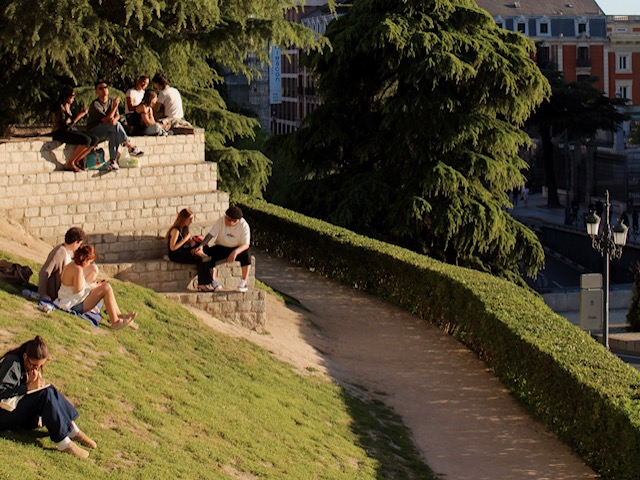
What I love about Spain (and Europe in general) is that there is a strong sense of community. Because most people live in apartments and cities are tightly packed, you know your neighbors, your friends are in walking distance, and it’s easy to bump into a familiar face when you’re out and about and make spur-of-the-moment plans. This is what I’m calling “The College Effect”.
Side note – that influencer’s handle is @hope.ss.chambers on Instagram. Look her up – I think she’s great.

The Céntrico Crew
To paint the picture of Céntrico, I have a few characters that I’d like to introduce you to.
First we have the bar owners, Gaby and Diego. They have a rule where after your second visit to the bar, they’ll ask your name and get to know you a little bit better, which after countless visits is why they easily know our go-to order. Originally from Venezuela and Colombia respectively, they bring a warm, inviting, and social atmosphere that’s unlike anywhere else in Madrid. They’ve created a special environment that everyone loves for a reason.
Ramón comes into the bar every single day for one bottle of Mahou. He’ll never drink two, and he’ll certainly never drink zero. He has lived in La Latina for his whole life, and while he has a few favorite neighborhood bars, it’s safe to say that Céntrico ranks at the top. He calls my dog, Charlie, “patitas” (paws in English) because of the click-clack sound his paws make as soon as Charlie enters the bar.
We also have Yolanda and Alvaro who practically live at Céntrico (the same way my husband, dog, and I do). They are always cracking jokes, chatting with our neighbors, and hanging out with Gaby and Diego while they work. Seeing them at Céntrico is like coming home to your parents at the end of a long day, and we’re always greeted with a hug and besitos.
And lastly, we have Vanesa, Alejo, Kate, Marina, Santiago, and so many more who became friends through Céntrico. We now attend each other’s birthday parties, support each other’s endeavors, take care of one another when sick, and have all bonded over drinks at Céntrico. Without the neighborhood bar, we might not have ever met them.
If Madrid is a college campus, these are my dorm-mates, and Céntrico is our favorite cafeteria to meet at. The only difference is that none of us plan to graduate.
The “Bar del Barrio”
In Spain, the neighborhood bar on your street is a cultural staple. There is a huge culture of drinking in Spain, but unlike the U.S., it isn’t with the purpose of getting drunk. The purpose of hanging out at the neighborhood bar is to socialize with your friends and neighbors over a caña or vermut.
Honestly, I can’t think of a single time in the U.S. that my husband and I went to a bar just to chat with strangers. But that’s what happens in Spain.
You go to the neighborhood bar and talk to the people around you, who usually are from the same street. And while we’re all from the same neighborhood, sometimes I’m amazed at how different we all are from one another. Some have lived on our block their whole lives, and others are immigrants who moved here from across the world.
In La Latina, that bar is Céntrico. And although it’s just a bar at the end of the day, it’s also a meaningful third space that doesn’t quite exist in the same way in the U.S.

Why This Doesn’t Exist in the U.S.
There are a lot of reasons why this way of life doesn’t exist in the same way in the U.S. Without getting into “us vs. them” politics or differences in safety which both play a role, here are the key structural and cultural reasons that I think are behind the difference.
The Suburbs Were Designed for Privacy
As Americans, we live in a very individualistic society that values privacy over community. According to a poll by Rocket Mortgage, only 30% of Americans know their neighbors beyond a casual level.
We’re told that the best way to live your life is to go to school, get your degree, buy a house in the suburbs, have kids and settle down. But we’re social primates, and nowhere within this plan does it recognize our need for community.
In the U.S., we don’t have access to third spaces the way Europeans do, and that’s simply because our cities aren’t designed that way. In Europe, most people meet their neighbors in the plaza or park as a way to catch-up in a free, public space. Those hardly exist in the U.S., and certainly not in rural areas.
We also have to take into account that the U.S. has the luxury of space, where Europeans do not. It’s natural for Americans to be more spread out due to geography alone, which plays a role in this isolation factor.
Car Culture Kills Spontaneity
Since communities are so spread out, Americans rely almost entirely on cars. Looking past the other more obvious problems like affordability and accessibility for non car-owners, this car culture has other social drawbacks.
When you’re driving from one place to another, there is no room for spontaneous bump-ins with friends or neighbors. It might seem small, but it has a huge impact on the way Americans live their lives in isolation compared to the European way of life.
I’m really not trying to bash the U.S. – but I do think there are implications that Americans aren’t even aware of until they leave.
Cultural Attitudes Around Community
Madrid is the capital of Spain, and is considered one of the major cities of Europe. But the feeling of living in the city is extremely warm, neighborly, and friendly. Compare that against the pace of New York City or even London, and I think Madrid is pretty unique in this regard.
There is a sense of safety in Madrid that invites friendliness in. People trust strangers in a way that I’ve never really experienced before. The cultural attitudes around community and trust foster an environment where you can be spontaneous, meet new people, and feel like you’re in the safe bubble of a college campus.
Not to mention that in Spain, you greet strangers with a besito (kiss) on each cheek. This small gesture is evidence of the warmth and closeness you feel in Spain which just doesn’t happen in the U.S.
Reflecting on How I’ve Changed As a Result
I am now close friends with Gaby, one of Céntrico’s owners, and we still laugh about how reserved and closed off I was when I initially moved to Madrid vs. the way I interact now. When we first came to Céntrico, we had no idea that the community was this close-knit and that we’d all become like a little family.
Moving from a culture of individualism in the U.S. to community in Spain has improved my quality of life immeasurably. If I had a hard day in the U.S., it was isolating and difficult to find time to be with friends and reconnect. Here, I know exactly where to find my community, and they’re only 10 meters away (yes, literally).

The Takeaway
Living in Europe and moving your life abroad is nothing without the people you meet along the way. Even if it feels scary, different, or if you’re not sure what the “norms” are, only good things come from diving into your community.
But it doesn’t take an international move to find your college crew in adulthood. Be kind to your neighbors and leave room for openness and spontaneity, and see what it does for your quality of life.
I’m curious if anyone else has had this experience after moving abroad. Let me know your thoughts in the comments!
Other blogs you might like:
Leave a Reply